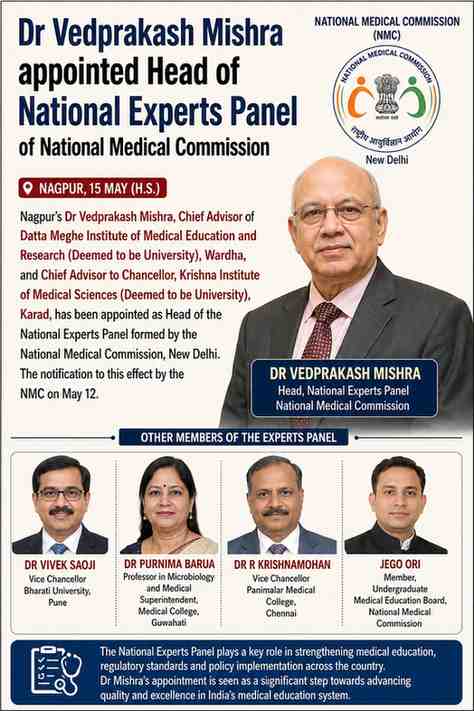
Dr Vedprakash Mishra has been appointed head of the National Experts Panel formed by the National Medical Commission to enhance medical education standards across India.
Dr Vedprakash Mishra, one of India’s senior-most medical education administrators and academic advisors, has been appointed as the head of the National Experts Panel constituted by the National Medical Commission (NMC).
The appointment was officially notified by the NMC on May 12, marking an important development in India’s evolving medical education framework.
Dr Mishra, who is based in Nagpur, currently serves as the Chief Advisor of Datta Meghe Institute of Medical Education and Research and also acts as Chief Advisor to the Chancellor of Krishna Institute of Medical Sciences.
The newly constituted experts panel is expected to play a significant role in strengthening academic standards, curriculum development and institutional quality across medical education institutions in the country.
NMC Strengthens Medical Education Oversight
The formation of the National Experts Panel comes at a time when the National Medical Commission is actively working to modernise and reform medical education in India.
Since replacing the Medical Council of India (MCI), the NMC has introduced several structural and regulatory changes aimed at improving transparency, accountability and academic excellence in the healthcare education system.
Officials said the newly formed panel will bring together experienced academicians, administrators and subject specialists to guide policy decisions and recommend improvements in medical education governance.
Experts believe the appointment of senior professionals with extensive institutional experience reflects the commission’s focus on strengthening quality standards in undergraduate and postgraduate medical education.
Dr Vedprakash Mishra’s Extensive Academic Background
Dr Vedprakash Mishra is widely regarded as one of the most experienced figures in India’s medical education sector.
Over the years, he has held multiple leadership positions in academic administration, institutional governance and healthcare education policy.
His association with the Datta Meghe Institute of Medical Education and Research in Wardha has been particularly notable, where he has contributed significantly to institutional development, research expansion and medical training initiatives.
The institution has emerged as a major centre for higher medical education and healthcare research under sustained academic leadership and expansion efforts.
Dr Mishra is also associated with the Krishna Institute of Medical Sciences in Karad, where he serves as Chief Advisor to the Chancellor and contributes to academic planning and institutional strategy.
National Experts Panel to Guide Key Reforms
Officials familiar with the development stated that the National Experts Panel will assist the NMC in evaluating critical issues related to medical education standards, curriculum implementation, faculty development and institutional compliance.
The panel is also expected to examine emerging challenges in medical training and suggest measures to improve healthcare education outcomes in India.
With rapid technological advancements and evolving healthcare demands, regulators have increasingly focused on aligning medical education with global best practices.
The experts panel is therefore likely to contribute recommendations on modern teaching methodologies, competency-based learning, digital healthcare education and research integration.
Observers believe the panel’s recommendations could influence future reforms in undergraduate medical education and institutional accreditation processes.
Distinguished Experts Included in Panel
Apart from Dr Vedprakash Mishra, the newly formed panel includes several senior academicians and healthcare administrators from different regions of the country.
Among the members is Dr Vivek Saoji, who currently serves as Vice Chancellor of Bharati Vidyapeeth University.
The panel also includes Dr Purnima Barua from Medical College Guwahati, who brings expertise in microbiology and hospital administration.
Another member is Dr R Krishnamohan associated with Panimalar Medical College.
The panel further includes Jego Ori from the Undergraduate Medical Education Board under the National Medical Commission.
Officials said the composition of the panel reflects regional representation and multidisciplinary expertise within India’s healthcare education system.
Focus on Improving Healthcare Education Standards
Medical education experts have welcomed the constitution of the panel, stating that India’s rapidly expanding healthcare sector requires continuous academic reforms and quality monitoring.
India currently has one of the world’s largest networks of medical colleges, with the number of institutions increasing significantly in recent years.
While expansion has improved access to medical education, regulators have also faced growing pressure to ensure uniform quality standards across institutions.
The National Experts Panel is expected to assist in addressing issues related to faculty shortages, infrastructure quality, clinical exposure and academic consistency.
Experts believe strong regulatory guidance will be crucial for producing skilled healthcare professionals capable of meeting India’s growing healthcare needs.
Importance of Competency-Based Medical Education
One of the major areas of reform in recent years has been the implementation of competency-based medical education (CBME) across Indian medical colleges.
The NMC has placed significant emphasis on shifting from traditional rote-learning approaches to skill-oriented and patient-centred medical training.
Officials indicated that the experts panel may contribute to refining the implementation of competency-based education models across institutions.
Areas such as practical training, communication skills, ethical medical practice and interdisciplinary learning are increasingly being prioritised within medical curricula.
The panel may also review how institutions are adapting to newer educational frameworks and whether additional policy interventions are required.
Growing Need for Research and Innovation
Another key challenge before India’s medical education system is the integration of research and innovation into mainstream academic training.
Experts have frequently argued that medical institutions must place greater emphasis on clinical research, scientific publications and evidence-based healthcare education.
Dr Mishra’s long association with research-oriented institutions is expected to contribute valuable insights in this area.
Officials believe the panel could recommend measures to encourage research collaborations, innovation ecosystems and digital healthcare education models within medical colleges.
The increasing use of artificial intelligence, telemedicine and data-driven healthcare systems has also created new demands for curriculum modernisation.
Role of NMC in Medical Governance
The National Medical Commission was established to reform medical education regulation and improve oversight mechanisms in India’s healthcare sector.
The commission oversees medical college approvals, academic standards, ethics regulation and professional licensing systems.
Over the past few years, the NMC has introduced multiple policy changes aimed at improving transparency and accountability within medical education institutions.
The creation of expert advisory groups forms part of broader efforts to strengthen evidence-based policymaking and institutional monitoring.
Observers believe the newly appointed panel could play a major advisory role in future policy frameworks concerning medical education quality and healthcare workforce development.
Recognition for Nagpur’s Medical Academic Community
Dr Vedprakash Mishra’s appointment has also been viewed as an important recognition for the medical academic community in Nagpur and Maharashtra.
Colleagues and healthcare education professionals described the appointment as acknowledgement of his decades-long contribution to institutional development and medical education leadership.
Academic leaders from various institutions have expressed confidence that his experience will help strengthen national-level healthcare education initiatives.
Several educators also highlighted the importance of involving experienced academic administrators in shaping future reforms within India’s medical education system.
Experts Expect Wider Reforms Ahead
Healthcare education experts believe the formation of the National Experts Panel signals the NMC’s intention to pursue broader reforms and deeper consultation in medical education governance.
The panel’s recommendations may eventually influence curriculum revisions, accreditation systems, faculty standards and institutional accountability frameworks across the country.
As India continues to expand its healthcare infrastructure and medical education capacity, policymakers are expected to focus increasingly on quality enhancement and professional competency.
Officials indicated that the experts panel will begin consultations and review processes in the coming months as part of the commission’s ongoing reform agenda.
The appointment of Dr Vedprakash Mishra as the head of the panel is therefore being viewed as a significant step toward strengthening India’s healthcare education ecosystem and promoting higher academic standards nationwide.
Key Insights
- The appointment of Dr Vedprakash Mishra to head the National Experts Panel of the National Medical Commission reflects the increasing emphasis on experienced academic leadership in shaping India’s evolving medical education and regulatory framework.
- The National Medical Commission, which replaced the Medical Council of India in 2020, has been central to reforms aimed at improving transparency, competency-based medical education, institutional accountability, and healthcare workforce expansion across the country.
- The inclusion of senior medical educators and administrators from institutions across different regions suggests an effort to ensure broader academic representation in policymaking and standards development within medical education.
- Expert panels constituted by the NMC often play an important role in curriculum reforms, accreditation mechanisms, faculty standards, undergraduate and postgraduate medical education policies, and institutional quality assessments.
- The participation of members from universities and medical colleges in Pune, Guwahati, Chennai, and other regions reflects the growing decentralisation of medical education expertise beyond traditional metropolitan centres.
- The appointment also highlights the expanding influence of deemed universities and private medical education institutions in India’s healthcare education ecosystem, particularly in the context of rising demand for medical seats and healthcare professionals.
- Strengthening expert-led advisory mechanisms becomes increasingly important as India seeks to address long-term healthcare challenges, including doctor shortages, uneven regional healthcare access, and the need for modernised medical training standards.
- The development comes at a time when India’s medical education sector is undergoing rapid expansion, with increased focus on digital learning, competency-based assessments, research integration, and alignment with global healthcare education benchmarks.
Inputs & Images: Hindusthan Samachar
Edited By: Akshaya Polepalli
Also Read: West Bengal Government Unveils Three-Phase Plan to Accelerate Bangladesh Border Fencing
Follow us on google news: Click Here